







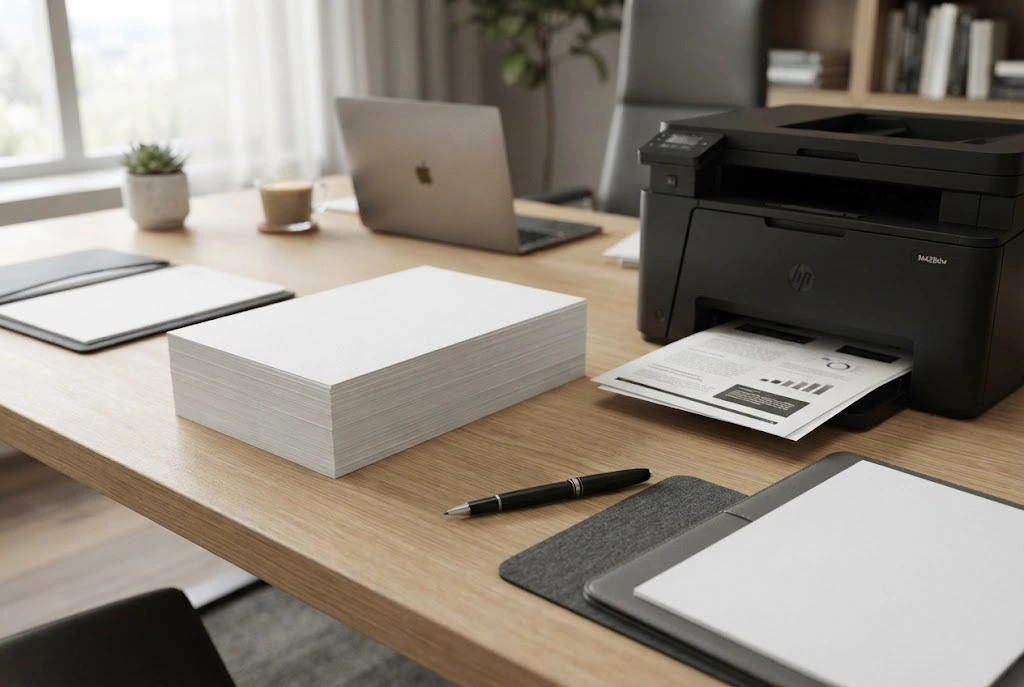
Legal paper white is a practical choice when you need a clean, professional-looking sheet for detailed documents, forms, contracts, notes, and other office tasks. Its longer format provides more vertical writing space than standard Letter paper while the white surface offers a clear background for text, graphics, signatures, and printed information.
Whether you are preparing documents for an office, organizing paperwork at home, or setting up a professional printing workflow, understanding legal paper size, paper quality, printer compatibility, and common uses can help you choose the right stock for the job.
What Is Legal Paper White?
Legal paper white generally refers to white paper produced in the Legal format, commonly measuring 8.5 × 14 inches or approximately 215.9 × 355.6 mm. It has the same width as US Letter paper but provides an additional three inches of length.
The term describes two separate characteristics: the paper’s physical size and its white finish. The size makes it useful for documents that need additional vertical space, while the white surface provides a clean appearance for both handwritten and printed material.
It is important to distinguish Legal paper from a legal pad. A legal pad is a particular style of writing pad, while Legal refers to a paper size. A white Legal sheet can therefore be used as loose office paper, printer paper, forms, or document stock without necessarily being a traditional legal pad.
Legal Paper White Size and Dimensions
The standard Legal format is 8.5 inches wide by 14 inches long. For comparison, US Letter is 8.5 × 11 inches, while A4 measures approximately 8.27 × 11.69 inches. Legal paper therefore provides substantially more vertical space than both Letter and A4.
This additional length can be useful when a document contains several sections, longer paragraphs, signature areas, schedules, or form fields. However, the appropriate size should always be determined by the requirements of the organization, printer, court, client, or document workflow involved.
Legal vs. Letter Paper
Legal and Letter paper share the same 8.5-inch width, but Legal paper is three inches longer. That difference can reduce the need for page breaks in documents where additional vertical space is useful.
Letter paper remains a common choice for everyday office correspondence and general printing. Legal paper is more appropriate when the longer page format is specifically useful or required.
Legal vs. A4 Paper
A4 is the widely used international paper format, measuring approximately 210 × 297 mm. Legal paper is wider and considerably longer at approximately 216 × 356 mm.
Because the proportions differ, a document designed for A4 should not automatically be assumed to print correctly on Legal paper. Always check the page-size settings before printing or converting a document between formats.
Why Choose White Legal Paper?
A white paper surface provides a neutral background that works well with black text, color graphics, signatures, charts, diagrams, and other printed elements. For professional documents, a clean white sheet can also provide a consistent appearance across a larger document set.
The main advantages include:
- Clear readability: White paper provides strong visual contrast for most standard text.
- Professional appearance: A clean white surface works well for formal documents and office materials.
- Additional writing space: Legal dimensions provide more vertical room than Letter paper.
- Versatility: The format can support printed documents as well as handwritten notes and forms.
- Easy organization: Legal-size documents can be sorted and stored when compatible folders, files, and filing systems are used.
Common Uses for Legal Paper White
Legal paper white can be useful in a range of professional and everyday situations. The right application depends on the required page size, paper weight, printer capabilities, and document-handling process.
Contracts and Agreements
Long contracts and agreements can benefit from the additional vertical space of Legal paper. Clauses, conditions, signature areas, and supporting information may fit more comfortably on a longer page.
Real Estate Documents
Property-related paperwork can contain multiple sections, disclosures, schedules, and signature fields. When Legal format is specified or preferred, white Legal paper can provide a practical surface for producing these documents.
Office Forms and Records
Organizations sometimes use longer paper formats for forms that contain multiple fields or instructions. The extra length can provide more room without making the page wider.
Legal and Administrative Paperwork
Some legal and administrative workflows use Legal-size pages. However, paper size requirements can vary between organizations and jurisdictions, so the required format should always be checked before preparing a final document.
Notes and Writing
White Legal paper can also be useful for handwritten notes, planning documents, outlines, and other situations where additional writing space is helpful. If you regularly work with written material, you may also find value in other writing and paper-based activities featured on PostingNest.
Choosing the Right Legal Paper Quality
Size is only one factor when selecting Legal paper. Paper weight, brightness, opacity, texture, and printer compatibility can affect the final result.
Paper Weight
Lightweight paper can be suitable for everyday printing, while heavier stock may provide a more substantial feel for presentations, forms, or documents that will be handled frequently. The appropriate weight depends on the printer and the intended use.
Brightness and Whiteness
A bright white surface can make printed text and graphics appear crisp and easy to read. When documents contain color elements, a consistent white background can also help maintain a clean visual presentation.
Opacity
Opacity becomes more important when documents are printed on both sides. Higher-opacity paper can reduce the visibility of content from the reverse side, helping the document remain easier to read.
Surface Finish
For ordinary office printing, a smooth writing and printing surface is generally practical. If the paper will be used for handwritten notes, signatures, or forms, choose a finish that works comfortably with the intended pen or writing instrument.
How to Print on Legal Paper White
Before printing, confirm that both your document and printer are configured for the Legal format. A document designed at 8.5 × 14 inches can produce unexpected results if the printer remains configured for Letter or another paper size.
- Open the document’s page or layout settings.
- Select Legal or enter 8.5 × 14 inches if the software requires custom dimensions.
- Load compatible Legal-size paper into the printer.
- Open the printer settings and select the matching Legal paper size.
- Check the print preview for margins, page breaks, headers, and footers.
- Print a test page when document formatting is particularly important.
Some printers support Legal paper while others are designed primarily for Letter, A4, or smaller formats. Always check the printer manufacturer’s specifications before purchasing large quantities of paper.
How to Store Legal Paper Properly
Paper quality can be affected by storage conditions. Keep unused Legal paper in a dry, clean environment away from excessive moisture, direct sunlight, and sources of heat.
Store paper flat when practical and keep opened packages protected from dust. If the paper is intended for a specific printer, keeping it in its original packaging until needed can also help maintain consistent handling and cleanliness.
Tips for Buying Legal Paper White
Before purchasing, consider the complete workflow rather than choosing paper based only on color or price.
- Confirm the paper is actually 8.5 × 14 inches.
- Check whether the paper is compatible with your printer.
- Choose an appropriate weight for the intended application.
- Consider opacity if you plan to print on both sides.
- Look for a smooth surface when printing detailed text or graphics.
- Purchase quantities that match your actual usage and storage capacity.
- Check whether your folders, filing cabinets, and other office equipment accommodate Legal-size sheets.
For broader information and practical articles across different subjects, you can also explore the PostingNest homepage.
Frequently Asked Questions About Legal Paper White
What size is legal paper white?
Legal paper typically measures 8.5 × 14 inches, or approximately 215.9 × 355.6 mm. It is the same width as US Letter paper but three inches longer.
Is legal paper the same as Letter paper?
No. Letter paper measures 8.5 × 11 inches, while Legal paper measures 8.5 × 14 inches. Both have the same width, but Legal paper is longer.
Is legal paper the same as A4?
No. A4 measures approximately 210 × 297 mm, while Legal measures approximately 216 × 356 mm. Their dimensions and proportions are different.
Can Legal paper be used in a regular printer?
It depends on the printer. Many office printers support Legal paper, but some devices do not. Check the printer’s supported paper sizes and tray specifications before printing.
Is white Legal paper suitable for everyday use?
Yes, when the printer, document format, and storage system support the size. For routine correspondence, however, Letter or A4 may be more practical depending on the local document standard and workflow.
What is the difference between Legal paper and a legal pad?
Legal paper describes a paper size, while a legal pad describes a type of writing pad. A legal pad may use a Legal-size sheet, but the terms do not describe exactly the same thing.
Final Thoughts
Legal paper white combines a clean white writing surface with a longer page format that can be useful for contracts, forms, administrative paperwork, notes, and other documents requiring additional vertical space. The standard Legal dimensions are 8.5 × 14 inches, making the format noticeably longer than Letter and A4.
The best choice depends on the document requirements, printer compatibility, paper quality, and filing system. By checking these factors before buying or printing, you can select Legal paper that works efficiently for both professional and everyday applications.