






Its portfolio goes beyond conventional HPLC columns. SIELC Technologies develops stationary phases, analytical columns, automated analyzers, HPLC systems, fluidic components, laboratory devices, method-development solutions, and specialized technologies for difficult analytical applications.
This makes SIELC an interesting example of how specialized scientific companies combine research, manufacturing, engineering, and application support to create practical laboratory technologies.
What Is SIELC Technologies?
SIELC Technologies is an American scientific and manufacturing company specializing in HPLC and liquid chromatography solutions. Its stated mission centers on making chromatography more accessible, efficient, and user-friendly while helping scientists achieve accurate and reproducible analytical results.
The company serves a broad professional audience, including analytical laboratories, research institutions, universities, pharmaceutical and chemical companies, government organizations, and industrial enterprises.
Rather than focusing on a single piece of laboratory equipment, SIELC has built a broader ecosystem around chromatographic analysis. Its products include separation columns, instrumentation, fluidics, custom phases, and supporting technologies that can be used across different analytical workflows.
How SIELC Technologies Supports Laboratory Innovation
Laboratory analysis often involves complex mixtures in which closely related compounds must be separated before they can be accurately identified or quantified. Chromatography provides a way to perform these separations, but the effectiveness of a method can depend heavily on column chemistry, operating conditions, instrumentation, and sample characteristics.
SIELC addresses these challenges through a combination of chromatography products and application-focused development. Its product portfolio includes multiple separation mechanisms, including reversed-phase, HILIC, ion exchange, mixed-mode, solid-core, and chiral approaches.
This breadth gives laboratories more options when a conventional separation method does not provide the selectivity or performance required for a particular application.
Companies researching other forms of specialized technology can also be viewed alongside SIELC’s approach to product development. For example, industrial innovation and technology solutions represent another area where specialized engineering can address highly specific operational requirements.
SIELC HPLC Columns and Separation Technologies
HPLC columns are one of the central parts of SIELC’s product portfolio. The company develops columns using different stationary-phase chemistries to support a wide range of separation problems.
Its portfolio includes Primesep, Newcrom, Obelisc, BIST, Cannsep, SHARC, Legacy, Lipak, Oligo, Cyralis, and other specialized column families.
According to SIELC, its columns are manufactured in the United States and undergo quality-control testing throughout the production process. The company offers columns for conventional HPLC as well as applications involving UHPLC and specialized separation requirements.
Mixed-Mode Chromatography
Mixed-mode chromatography combines different separation mechanisms within a single stationary phase. This can be useful when a conventional reversed-phase method does not provide sufficient selectivity.
SIELC’s Primesep and Obelisc families are examples of its mixed-mode approach. These technologies are designed to give analysts additional control over retention and selectivity when working with challenging compounds and complex mixtures.
BIST Technology
BIST, or Bridge Ion Separation Technology, is another SIELC-developed approach to liquid chromatography. The technology is intended to expand the range of separations that can be performed by providing an additional mechanism for handling charged molecules.
This type of specialized chemistry illustrates the company’s focus on solving analytical problems that may be difficult to address using conventional chromatography alone.
Specialty and Custom Phases
Not every analytical challenge can be solved using an off-the-shelf stationary phase. SIELC therefore also develops specialty phases and supports custom separation requirements.
Custom chromatography can be particularly useful when a laboratory is working with unusual compounds, complex mixtures, or analytical methods that require a specific combination of selectivity and operating conditions.
SIELC Laboratory Instruments and Devices
SIELC’s innovation extends beyond chromatography columns. The company also develops analytical instrumentation and laboratory automation products.
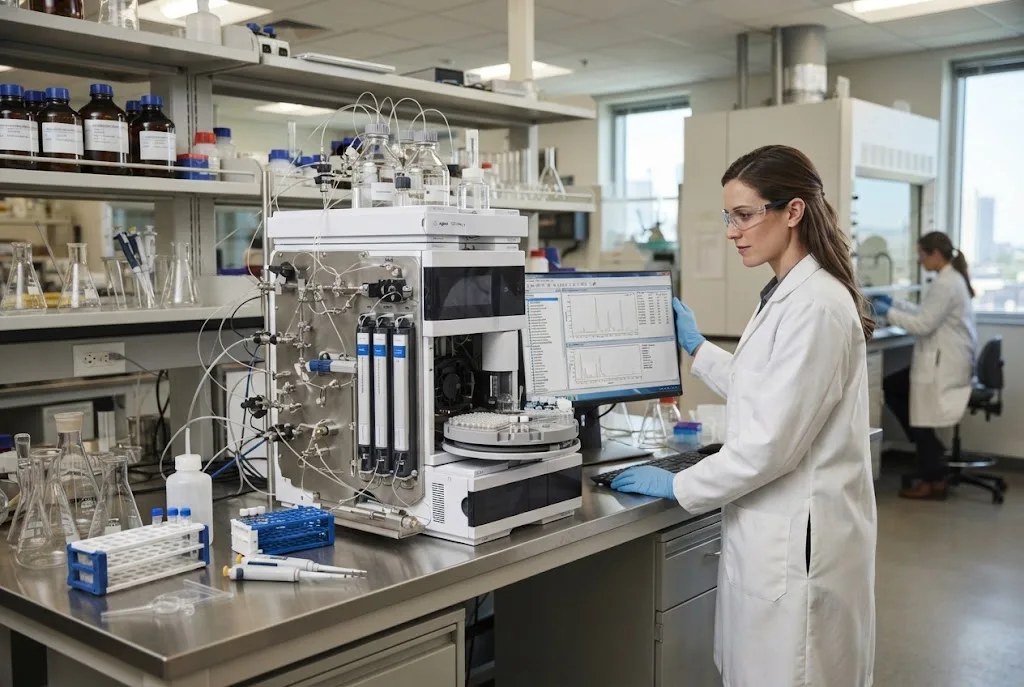
Its portfolio includes the Alltesta family of automated analyzers, the Cromite HPLC system, Samplify automated sampling technology, mini autosamplers, high-pressure switching valves, syringe pumps, UV-Vis detectors, and other laboratory components.
These products are designed to address different parts of an analytical workflow, from sample handling and injection to separation and detection.
Alltesta Automated Analyzers
The Alltesta product family provides automated analytical capabilities based on HPLC technology. Different configurations are available for specific laboratory requirements, including isocratic and gradient analysis.
Automation can help laboratories standardize repetitive analytical processes, reduce manual handling, and create more consistent workflows.
Cromite HPLC System
The Cromite HPLC system is part of SIELC’s instrumentation portfolio and is designed for liquid chromatography applications. Its inclusion in the company’s broader ecosystem demonstrates SIELC’s strategy of developing both separation chemistry and supporting analytical hardware.
Laboratory Fluidics and Components
Reliable chromatography depends on more than columns and pumps. Tubing, fittings, filters, adapters, valves, and other fluidic components can affect system performance and usability.
SIELC therefore offers fluidic components and column hardware alongside its primary chromatography products. This approach allows laboratories to source a wider range of components from a specialized chromatography manufacturer.
HPLC Method Development and Analytical Support
Choosing an HPLC column is only one part of developing a successful analytical method. Analysts may need to evaluate mobile phases, buffer concentrations, pH, organic modifiers, flow conditions, detection methods, and other parameters.
SIELC maintains research and development capabilities focused on HPLC method development and new column development. The company states that it provides method screening and optimization services for customers and develops application-specific solutions for difficult separations.
This application-oriented approach can be valuable when a laboratory knows what it needs to analyze but has not yet established an efficient separation method.
Research and Development at SIELC Technologies
Research and development is central to SIELC’s business model. The company develops new stationary phases and analytical technologies rather than relying exclusively on established chromatography products.
Its R&D capabilities include HPLC and UHPLC systems, LC-MS instrumentation, multiple detection technologies, chemical analysis equipment, particle analysis, and systems used to develop new materials.
The company also develops new stationary phases when existing column chemistries cannot provide the required separation. This creates a direct connection between customer analytical problems and product development.
Manufacturing and Quality Control
SIELC combines research and development with in-house manufacturing capabilities. Its column production operations cover different column sizes, from capillary formats to preparative columns.
The company describes a multi-stage quality-control process designed to maintain product consistency and reproducibility. Its manufacturing operations also use proprietary hardware and software for managing production data and processes.
For laboratories, manufacturing control matters because analytical methods often depend on consistent column performance. Variability in chromatography products can affect retention, resolution, reproducibility, and method transfer.
Who Uses SIELC Technologies Products?
SIELC’s customer base spans several areas of scientific and industrial research. Its solutions can be relevant to organizations that depend on liquid chromatography for analytical testing, research, quality control, method development, or product development.
- Analytical laboratories
- Research institutions
- Universities
- Pharmaceutical companies
- Chemical companies
- Government laboratories and organizations
- Industrial enterprises
- Specialized scientific research teams
The exact product required depends on the analytical objective, compounds being investigated, sample characteristics, existing laboratory equipment, and desired separation mechanism.
Applications of SIELC Chromatography Solutions
SIELC’s technologies are designed for a broad range of analytical applications. Its product portfolio includes solutions associated with small molecules, lipids, oligonucleotides, proteins and peptides, charged compounds, cannabis analysis, inorganic analysis, and other specialized areas.
The company’s chromatography technologies include reversed-phase, HILIC, ion-exchange, mixed-mode, solid-core, and chiral separation approaches. Having several mechanisms available can be important when a standard C18-style reversed-phase method does not provide enough selectivity.
Pharmaceutical and Chemical Analysis
Pharmaceutical and chemical laboratories frequently need reliable separation methods for raw materials, intermediates, active compounds, impurities, and finished products. HPLC is widely used for these analytical tasks, making column chemistry and method development important parts of laboratory workflows.
Research and Academic Laboratories
Universities and research institutions may work with compounds that have not been extensively characterized or that require unusual analytical methods. Specialized columns and method-development support can help researchers investigate complex samples more efficiently.
Complex Mixture Analysis
Complex mixtures can contain compounds with similar physical and chemical characteristics. In these situations, additional selectivity from mixed-mode, ion-exchange, HILIC, or other chromatographic mechanisms may help analysts achieve a usable separation.
What Makes SIELC’s Approach Different?
SIELC’s approach is notable because it combines several parts of the analytical technology ecosystem under one company. Instead of concentrating solely on chromatography columns, it works across separation chemistry, instrumentation, fluidics, method development, manufacturing, and laboratory engineering.
This integrated approach can be useful for organizations looking for more than a standard catalog product. A difficult analytical problem may require changes to the column chemistry, method conditions, sample handling, or instrumentation rather than a single isolated component.
The broader technology landscape contains many companies following a similar specialization strategy. PostingNest’s coverage of technology-driven business solutions provides another example of how specialized technology providers can focus on solving specific operational and technical challenges.
How to Evaluate an HPLC Solution
Laboratories should evaluate an HPLC product based on the analytical problem rather than selecting a column or instrument solely because it is widely used.
Important considerations include:
- Target compounds: Understand the chemical properties and expected concentration range of the analytes.
- Required selectivity: Determine whether conventional reversed-phase chromatography provides adequate separation.
- Sample complexity: Complex samples may require mixed-mode, HILIC, ion-exchange, or other specialized approaches.
- Detection method: Make sure the selected separation works with the available detector and analytical workflow.
- Column dimensions: Column size and particle characteristics should match the laboratory’s system and performance requirements.
- Method transfer: Consider whether the method can be reproduced across instruments or laboratories.
- Long-term reliability: Reproducibility, durability, and quality control are important for routine analytical work.
- Application support: For difficult separations, access to method-development expertise can be as important as the hardware itself.
The Role of Innovation in Modern Chromatography
Analytical laboratories increasingly need methods that are faster, more reproducible, easier to automate, and capable of handling complex samples. These demands create opportunities for innovation in stationary phases, instrumentation, sample preparation, automation, and data management.
SIELC’s product development reflects several of these trends. Its portfolio combines specialized separation chemistries with automated analytical devices and supporting hardware, giving laboratories options for building more integrated workflows.
New developments in chromatography are particularly valuable when traditional methods require extensive optimization or fail to separate compounds adequately. Specialized stationary phases can provide another path toward improved selectivity without requiring an entirely different analytical platform.
SIELC Technologies and the Future of Analytical Science
Analytical science continues to evolve as laboratories work with increasingly complex samples and demand greater automation and reproducibility. Companies developing both analytical chemistry and laboratory technology are positioned to contribute to this evolution.
SIELC’s continued development of HPLC columns, instrumentation, laboratory automation, and specialized separation technologies shows how a focused scientific manufacturer can expand its role beyond a single product category.
Its work is particularly relevant to laboratories that encounter analytical problems requiring more specialized selectivity, custom development, or integrated instrumentation solutions.
Frequently Asked Questions About SIELC Technologies
What does SIELC Technologies specialize in?
SIELC Technologies specializes in HPLC and liquid chromatography solutions, including chromatography columns, stationary phases, analytical instruments, fluidic components, laboratory devices, and method-development services.
Where is SIELC Technologies based?
SIELC Technologies is a U.S.-based scientific and manufacturing company. Its official website lists its address in Wheeling, Illinois.
What types of HPLC columns does SIELC offer?
SIELC offers multiple column families, including Primesep, Newcrom, Obelisc, BIST, Cannsep, SHARC, Legacy, Lipak, Oligo, Cyralis, and specialty columns.
Does SIELC develop custom chromatography solutions?
Yes. SIELC describes custom phase development and method-development capabilities for analytical challenges that may not be adequately addressed by standard commercial phases.
Who can benefit from SIELC products?
Analytical laboratories, universities, research institutions, pharmaceutical and chemical companies, government organizations, and industrial enterprises can use chromatography and analytical technologies such as those offered by SIELC.
Does SIELC manufacture its own chromatography products?
SIELC describes its own column manufacturing, instrumentation production, quality-control operations, and research and development capabilities, allowing it to develop and manufacture a range of chromatography products and analytical technologies.
Final Thoughts
SIELC Technologies represents a specialized approach to scientific innovation, combining chromatography research, product development, manufacturing, instrumentation, and application support. Its portfolio covers much more than conventional HPLC columns, extending into automated analyzers, laboratory devices, fluidics, custom phases, and method-development solutions.
For laboratories facing complex separation challenges, the value of a chromatography supplier often depends on more than the availability of a standard product. Selectivity, reproducibility, application support, manufacturing quality, and the ability to develop specialized solutions can all influence the success of an analytical workflow.
By continuing to develop separation chemistry and analytical instrumentation together, SIELC Technologies has established a distinctive position within the specialized HPLC and laboratory technology market.