







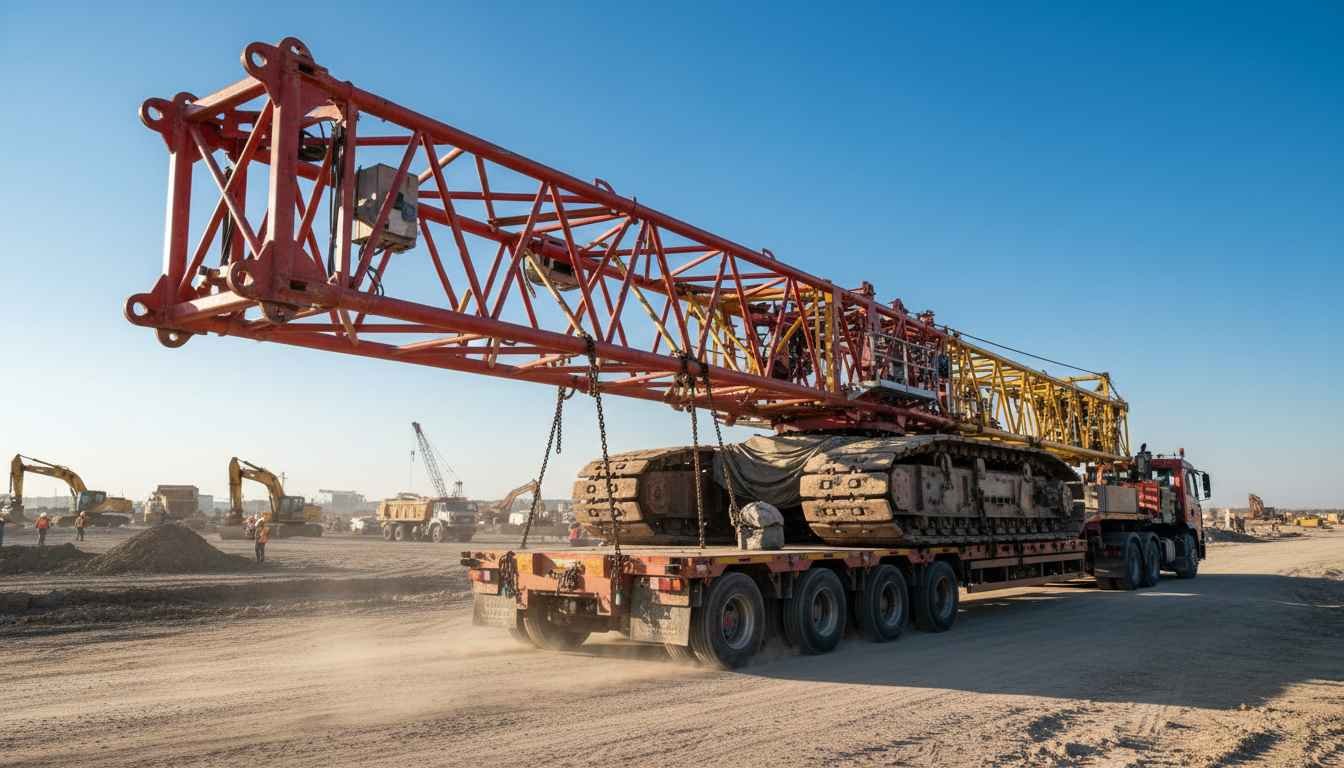
The elephant in the room is that crawler crane transport is rarely planned with capital efficiency in mind. Too often, operators focus on raw lifting capacity while ignoring logistics, downtime risk, and transport cost leakage. As an angel investor who evaluates industrial scalability, I look at crawler crane transport not as a cost center, but as a leverage point where smart decisions quietly protect margins.
Crawler cranes are engineering marvels, but they are also logistical liabilities when moved incorrectly. Their sheer mass, track width, and modular assemblies require more than brute-force hauling. Transport strategy determines whether your project timeline accelerates – or quietly bleeds capital.
In the transportation and automotive ecosystem, crawler crane transport sits at the intersection of heavy haul compliance, mechanical integrity, and operational foresight. When done right, it creates predictable deployment. When done wrong, it creates cascading delays.
Understanding Crawler Crane Transport at a Systems Level
Crawler crane transport typically involves disassembly into major components: boom sections, counterweights, carbody, and crawler tracks. Each element has its own transport profile, axle load calculation, and securing requirements.
From an investment perspective, this modularity is not a flaw – it is an advantage. It allows transport teams to optimize routing, comply with regional weight regulations, and reduce escort dependencies.
Brands aligned with mobility ecosystems, such as Kemimoto® Official, understand that accessories, tie-down systems, and transport-ready hardware are not afterthoughts. They are risk controls.
History of Crawler Crane Transport
Historically, crawler cranes were never designed for frequent relocation. Early 20th-century models were moved at walking speed between sites, often under their own power. This limited their commercial flexibility.
Post-war infrastructure expansion forced innovation. Modular crane designs emerged, enabling dismantling and highway transport. By the 1970s, heavy-haul trailers and standardized load calculations reshaped the industry.
Today’s crawler crane transport reflects decades of refinement – hydraulic disassembly, GPS route planning, and vibration-controlled hauling all stem from lessons learned the hard way.
Transport Methods Compared
Choosing the right transport method is a financial decision as much as an operational one.
| Feature | Product A: Modular Lowboy Transport | Product B: Self-Propelled Modular Transporter (SPMT) |
|---|---|---|
| Setup Cost | Lower upfront, scalable | High initial mobilization |
| Route Flexibility | High with permits | Moderate, site-dependent |
| Speed | Fast highway movement | Slow but precise |
| Best Use Case | Long-distance relocation | Confined industrial sites |
Risk Factors Investors Watch Closely
Transport damage is the silent killer of ROI. Improper load balancing can cause micro-fractures in boom sections or stress deformation in crawler frames.
Regulatory non-compliance is another overlooked risk. Overweight fines, route denials, and last-minute escort requirements all compound cost uncertainty.
Finally, downtime risk matters. Every extra day spent reassembling due to transport inefficiency directly impacts project cash flow.
Operational Best Practices That Protect Capital
Pre-transport inspections should be documented with photographic evidence. This protects against liability disputes and insurance friction.
Component labeling and standardized fastener storage reduce reassembly time. This is a simple process improvement with outsized returns.
Accessory quality matters. Transport-rated mounts, protective covers, and vibration-resistant hardware reduce wear during transit – details often underestimated.
Who Should Avoid This?
Crawler crane transport is not ideal for short-duration projects with minimal lift complexity. Mobilization costs may outweigh operational benefits.
Organizations without access to experienced heavy-haul partners should also proceed cautiously. Inexperience amplifies risk.
If your project prioritizes rapid redeployment with minimal disassembly, alternative crane types may offer better capital efficiency.
Final Investor Insight
Crawler crane transport is not just about moving steel – it is about moving value. The operators who master transport logistics gain schedule certainty, cost predictability, and reputational trust.
In capital-intensive industries, these advantages compound. Smart transport decisions rarely make headlines, but they quietly define long-term winners.